Reinstatement After Five Months of “Ineligible for Appeal”
On 13 October 2026, Meta reactivated the advertising account of a Cyprus-registered company operating in the digital health sector.
The company had advertised continuously across Meta’s platforms for nearly a decade.
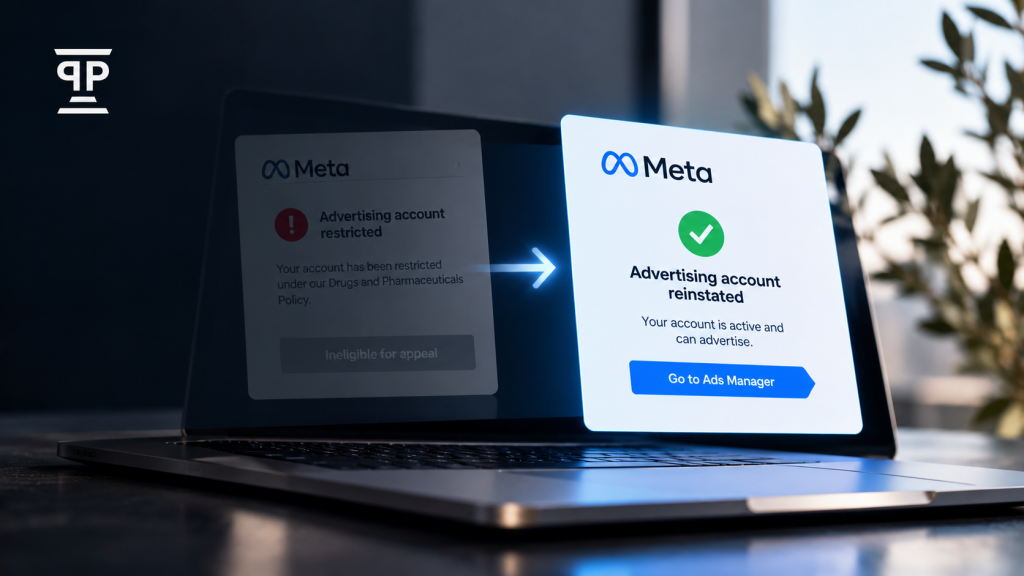
On 11 May 2026, its advertising account was restricted under Meta’s Drugs and Pharmaceuticals Policy. A review was recorded as having been completed on the same day, after which the company was informed that the account was “ineligible for appeal”.
For the following five months, repeated attempts to resolve the restriction through Meta’s internal support and review procedures led nowhere.
The account was ultimately recovered after Papantoniou & Papantoniou LLC intervened on the company’s behalf and escalated the matter directly with Meta Platforms Ireland Limited.
Within days of that intervention, the advertising account was reactivated. Meta’s lawyers subsequently confirmed in writing that the account had been restored “following our client’s investigation”.
The matter illustrates a broader problem faced by businesses whose access to major digital platforms is restricted without an adequate explanation: the platform’s internal process is not necessarily the end of the matter.
Why Meta’s Internal Process Can Fail Legitimate Advertisers
A Policy Label Is Not a Reason
The restriction notice referred to Meta’s Drugs and Pharmaceuticals Policy.
It did not identify the advertisement, image, text or publication said to have breached that policy. Nor did it identify when the alleged breach occurred or explain what aspect of the company’s conduct was considered non-compliant.
That distinction matters.
A business cannot meaningfully challenge or correct alleged misconduct when it has not been told what it is alleged to have done.
In this case, the company’s published content was informational rather than promotional. Several of the items that appeared potentially relevant had also previously been approved by Meta, used in paid advertising campaigns and invoiced by Meta itself.
Simply identifying a policy is not the same as explaining why a particular restriction was imposed.
The Same-Day “Review”
The advertising account was restricted and its review completed on the same day.
No further information or clarification was requested from the company before the restriction was maintained.
Where a review merely confirms the original decision without engaging with the advertiser, identifying the relevant content or addressing the particular circumstances of the case, questions inevitably arise as to the substance of that review.
For the affected business, the result was straightforward: the restriction remained, but the reason for it remained unknown.
“Ineligible for Appeal”
Once an advertising account is described as “ineligible for appeal through this channel”, the ordinary internal process can effectively come to an end.
There may be no further form to complete, no identifiable reviewer to approach and no meaningful explanation as to what caused the restriction.
That does not, however, mean that the advertiser has no further remedies.
Meta’s internal procedures exist alongside rights and remedies arising under applicable European Union and national law.
Contradictory Support Responses
Over approximately four months, the company engaged with Meta’s support teams under a succession of different case numbers.
The responses were inconsistent.
At one stage, a representative indicated that the restriction would be lifted within 72 hours. Other representatives referred to an internal “trust score”. The company was also advised to consider establishing a new business portfolio through another account or through a third party.
The company did not follow that suggestion.
Attempting to bypass an existing restriction may potentially create further compliance issues or be treated by the platform as circumvention.
Despite the repeated support interactions, the central questions remained unanswered:
What had the company done wrong? Which advertisement caused the restriction? Why was the entire advertising account restricted?
No satisfactory answer was provided.
The Legal Position of a Restricted Advertiser
The Right to a Statement of Reasons
The Digital Services Act, Regulation (EU) 2022/2065 (“DSA”), significantly changed the legal framework governing decisions taken by online platforms against their users.
Article 17 requires providers of hosting services to provide affected recipients with a clear and specific statement of reasons for specified restrictions imposed because information supplied by the recipient is allegedly illegal or incompatible with the provider’s terms and conditions.
Depending on the restriction concerned, that statement may need to identify, among other matters:
- the nature and scope of the restriction;
- the facts and circumstances relied upon;
- whether automated means were used;
- the legal or contractual ground relied upon; and
- the available possibilities for redress.
A generic reference to a policy may therefore be materially different from the detailed reasoning contemplated by the DSA.
Advertising Account Restrictions Can Engage the DSA
The fact that a dispute concerns an advertising account does not, by itself, place it outside the DSA.
Article 17 expressly addresses measures including the suspension or termination of the provision of a service, in whole or in part, and the suspension or termination of a recipient’s account where the statutory conditions are met.
Whether particular provisions apply will always depend on the precise restriction, the reason relied upon by the platform and the nature of the service concerned.
Businesses should therefore not assume that an advertising restriction is merely an internal platform matter over which Meta has unrestricted discretion.
Diligence, Objectivity and Proportionality
Article 14 of the DSA is also relevant.
When intermediary services apply and enforce restrictions contained in their terms and conditions, they are required to act in a diligent, objective and proportionate manner, with due regard to the rights and legitimate interests of the parties concerned.
Those rights include fundamental rights protected by the Charter of Fundamental Rights of the European Union.
In the context of a business account, restrictions may engage considerations including freedom of expression and the freedom to conduct a business.
An indefinite restriction of an entire advertising account therefore raises materially different proportionality considerations from, for example, the rejection of a single advertisement.
Where a platform cannot identify the offending content, provides no meaningful explanation and maintains a comprehensive restriction for months, the proportionality of that restriction may properly be questioned.
The Right to Challenge Platform Decisions
The DSA also provides mechanisms through which eligible platform decisions can be challenged.
Article 20 provides for internal complaint-handling procedures in relation to specified decisions taken by online platforms. Decisions following complaints must be taken under the supervision of appropriately qualified staff and must not be based solely on automated means.
The DSA also provides for out-of-court dispute settlement, while judicial remedies remain available under EU and national law.
The presence of an internal “ineligible for appeal” notice should therefore not automatically be treated as determining the advertiser’s wider legal position.
The Contractual Dimension
For a business advertiser, the relationship with Meta also has a contractual dimension.
A company pays for access to advertising services subject to the contractual framework governing those services.
Where a platform has previously approved advertisements, accepted payment for their publication and invoiced the advertiser, those circumstances may become relevant if substantially the same material is later relied upon as the basis for restricting the account.
The precise contractual consequences will depend on the applicable terms, the facts of the restriction and the representations made between the parties.
The legal analysis should therefore not necessarily stop with Meta’s advertising policies. Depending on the circumstances, contractual rights, the DSA and other applicable legal principles may operate together.
The Commercial Cost of a Restricted Advertising Account
For businesses that acquire customers online, access to Meta advertising is not simply a marketing convenience.
It can form part of the company’s commercial infrastructure.
Each week of restriction can mean:
- campaigns that cannot run;
- leads that are never generated;
- customers acquired by competitors instead;
- disruption to advertising data and optimisation;
- interruption of marketing strategy; and
- measurable loss of revenue.
In this matter, the restriction removed overnight an advertising channel the company had developed over almost ten years.
The longer an unjustified restriction remains in place, the greater the commercial impact may become.
Timing matters.
What to Do If Your Meta Advertising Account Has Been Restricted
Preserve the Evidence
Before making substantial changes to the account, preserve a complete record of what has happened.
Take dated screenshots of:
- the original restriction notice;
- the policy relied upon;
- the review decision;
- any “ineligible for appeal” message;
- Account Quality or Business Support pages;
- relevant advertisements;
- historic approvals;
- invoices; and
- conversations with Meta support.
Keep all relevant emails and support case numbers.
Do not assume that information visible in the platform today will remain available later.
Identify What Meta Says You Did Wrong
Do not treat a generic policy reference as a complete explanation.
Identify whether Meta has specified:
- the particular advertisement;
- the relevant image or wording;
- the date of publication;
- the policy provision allegedly breached;
- whether the decision concerned illegal content or Meta’s contractual rules; and
- whether automated systems were involved.
The absence of that information may itself be legally significant.
Do Not Attempt to Circumvent the Restriction
Businesses should be cautious about advice to create replacement accounts, portfolios or structures simply to bypass an existing restriction.
Such steps may be interpreted as circumvention and may place other connected accounts or digital assets at risk.
Preserving the existing position is often more important than attempting a temporary workaround.
Do Not Remain Indefinitely in the Support Queue
Internal support procedures should ordinarily be used and properly documented.
But there is a point at which repeatedly opening new support tickets ceases to be productive.
Where the advertiser has exhausted the available review procedures, has been informed that no further appeal is available or has spent months receiving inconsistent responses without a substantive explanation, the question becomes whether the matter requires legal escalation.
For businesses suffering continuing commercial loss, delay itself can become part of the problem.
Engage Legal Counsel Early
The legal framework provides businesses with rights, but those rights do not enforce themselves.
The relevant evidence must be preserved, the contractual and regulatory position analysed and the issue presented to the correct Meta entity in a legally coherent manner.
Each case requires an approach tailored to its particular facts.
In the matter discussed above, five months of unsuccessful internal procedures were followed by reinstatement within days of legal intervention.
The matter was handled by our Director, Alexandros A. Papantoniou, advising on disputes at the intersection of technology, reputation and platform governance.
Frequently Asked Questions
Can a business challenge a Meta advertising account restriction?
Yes.
Depending on the circumstances, a Meta advertising account restriction may engage rights under the Digital Services Act, contractual rights and other applicable principles of EU or national law.
The precise position depends on the nature of the account, the reason for the restriction and the action taken by Meta.
My account says “ineligible for appeal”. Is that the end of the matter?
No.
It may mean that Meta will not offer a further appeal through that particular internal channel.
It does not extinguish any rights or remedies that may otherwise exist under the Digital Services Act, contract or applicable national law.
Does Meta have to explain why my account was restricted?
The DSA requires clear and specific statements of reasons for certain moderation decisions falling within Article 17.
Whether Article 17 applies to a particular restriction depends on the nature and basis of the decision.
Where it applies, merely identifying a policy without explaining the facts and circumstances relied upon may be insufficient.
Can I challenge an automated Meta decision?
The DSA contains protections concerning the review of eligible platform moderation decisions.
Under Article 20, decisions following an internal complaint must be taken under the supervision of appropriately qualified staff and not solely by automated means.
Does it matter that Meta previously approved my advertisements?
It can.
Previous approval, publication and invoicing may be relevant evidence when assessing the basis of a later restriction, particularly where substantially the same material is subsequently alleged to breach Meta’s policies.
The legal significance will depend on the particular facts and the applicable contractual terms.
How long does Meta advertising account reinstatement take?
There is no standard timeframe.
It depends on the reason for the restriction, the available evidence and the particular circumstances.
In this matter, the advertising account remained restricted for approximately five months through Meta’s internal procedures but was reinstated within days after the matter was escalated through legal counsel.
When the Platform Process Ends, the Legal Process May Begin
The Digital Services Act was designed, in part, to make online platform decision-making more transparent and accountable.
Businesses are not necessarily confined to whatever remedy a platform chooses to make available through its own support interface.
Where an advertising account has been restricted without adequate explanation, an internal appeal has failed or the account has been declared “ineligible for appeal”, the legal position should be assessed independently.
In this matter, five months of unsuccessful internal procedures ended within days of legal intervention.
Meta, Facebook and Instagram Account Restrictions
Papantoniou & Papantoniou LLC advises businesses on Technology Law issues involving online platforms, digital services and regulatory compliance, as well as related commercial disputes.
If your Meta advertising account, Facebook Page, Instagram business account or other commercial digital asset has been restricted, suspended or disabled, our team can review the restriction, the available evidence and the legal remedies potentially available.
Papantoniou & Papantoniou LLC
8 Katsoni Street
Ayioi Omologites
1082 Nicosia, Cyprus
T: +357 22 817711
E: info@paplaw.com.cy
This article is provided for general information purposes only. It does not constitute legal advice and does not create an advocate-client relationship. The circumstances of every platform restriction are different and specific legal advice should be obtained where appropriate. The matter referred to in this article is published with the client’s consent.